
Key Takeaways
- Venu Nair took over Shoppers Stop in November 2020, and by the December 2021 quarter it reported a net profit of ₹77.32 crore with zero net debt.
- Nine weeks in, Shoppers Stop had already saved ₹390 crore, and Nair ran cost, balance sheet and growth in parallel rather than one at a time.
- Boards that wait for a crisis to be visible lose the weeks that matter most, and the right candidate may look like they are taking a weaker job.
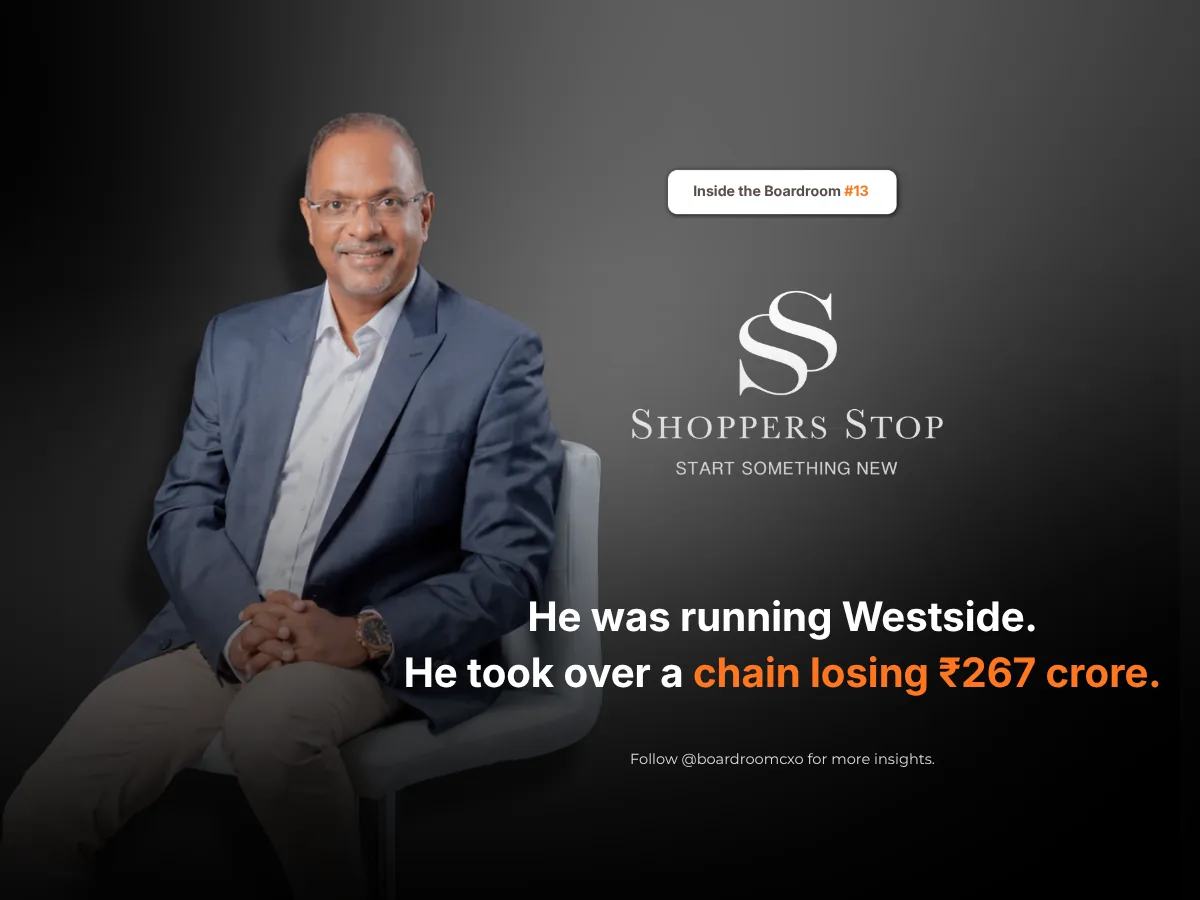
In November 2020, a man walked away from the top job at Westside to run Shoppers Stop. Department stores in India live inside shopping malls, and that year, malls were the last place anyone wanted to be. In the quarter before he arrived, footfall had run at about a fifth of the previous year's.
Nobody wanted that job.
Losing Nearly Half the Business in a Year
By March 2021, Shoppers Stop had lost 44 percent of its revenue in twelve months. Sales fell to ₹1,973 crore. The loss for the year was ₹267 crore.
Venu Nair had spent 27 years in retail before he took the job: Marks and Spencer Reliance, Madura, Arvind, Westside. The obvious move, for anyone with that résumé, was to wait for the malls to fill again and let the recovery do the work. Most leaders in that seat would have done exactly that.
He did not.
Nine Weeks to Renegotiate Everything
The company had set a cost-savings target of ₹450 crore, and he kept going after it line by line. Nine weeks into the job, in January 2021, he told analysts the company had renegotiated every cost and had already saved ₹390 crore. A rights issue was raised and oversubscribed, ₹125 crore of debt was repaid, and the company turned net cash, all while footfall was still a fraction of what it had been a year earlier.
Building Online While the Fire Was Still Burning
At the same time, with more than 50 stores already live on Amazon, he pushed the live catalogue to 61,000 items, taking online from 1.5 percent of sales to 6 percent. Then, with the core business still being repaired, he committed to 10 to 12 new stores, most of them in tier 2 cities. Most turnaround plans fix one thing at a time. His ran three in parallel: cost, balance sheet, and growth.
The Numbers Turned, Then He Left
By the December 2021 quarter, Shoppers Stop reported a net profit of ₹77.32 crore against a loss of ₹25.11 crore a year earlier, with zero net debt. A year after that, quarterly revenue had reached ₹1,137 crore.
In August 2023, with the balance sheet clean, he resigned to spend more time with his family. The stock fell 8 percent in early trade that day.
The market does not price a leader while he is fixing things. It prices him on the day he leaves.
The Boardroom Read
Most boards wait for a crisis to be visible before they start looking for the leader who can fix it. By the time the numbers are frightening enough to justify an unconventional hire, the nine weeks that mattered most are already gone.
Nair's turnaround worked because three things happened at once, not in sequence: costs cut to the bone, the balance sheet repaired through a rights issue and debt repayment, and a real online push built alongside the recovery, not after it. That is a harder hire to make than most boards are prepared for, because the candidate willing to take it looks, on paper, like someone walking away from a stronger job into a weaker one.
The market does not remember who inherited the recovery. It remembers who was in the room before there was one.
Sources
- Shoppers Stop, Shoppers Stop Q3 FY21 Earnings Conference Call, January 2021
- Business Standard, Shoppers Stop sinks 8% as Venugopal Nair tenders resignation as MD & CEO, August 2023
- Business Standard, Shoppers Stop slips after Q3 PAT drops 19% YoY to Rs 63 cr, January 2023
- Business Standard, Shoppers Stop Q3 net profit at Rs 77.32 cr; sales up 33.82% at Rs 95,811 cr, January 2022
- Business Standard, Shoppers Stop Q4 net loss narrows to Rs 24 cr; total income declines 3.7%, May 2021
Related Reading
He Ran India's Biggest Luggage Company. Then He Bought the Rival One-Tenth Its Size.
Read → R · 02 Founder Leadership · September 2026Costs Were Rising Everywhere. Sameer Khetarpal Cut Domino's Prices Anyway.
Read → R · 03 Founder Leadership · August 2026C K Venkataraman: How Tanishq Fixed Years of Being Wrong About India
Read →Need a leader who will take the job before the recovery is visible?
Whether it's a retail turnaround, a balance sheet under pressure, or a growth story that needs rebuilding from the ground up, we place the CEOs, CFOs, and ops leaders who take the fix on, not the ones who wait for it to be safe.
Brief Us on a Mandate See all Sales & Retail roles we fill →